Two traders take the same trade. Only one of them actually pays for it.
The funded trader is sized in on a setup she half-trusts. If it works, it's a nice afternoon. If it doesn't, it's friction. A small debit against a number that already has a lot of zeros. She'll close the day inside her normal range either way. The trade doesn't change her life in any direction.
The small-account trader takes the same setup, scaled down. Same chart, same logic, same hesitation. But for her, that trade is not friction. It is a chunk of the only engine she has. Because the small account doesn't survive by winning big. It survives by compounding, and compounding is the one thing overtrading quietly disassembles.
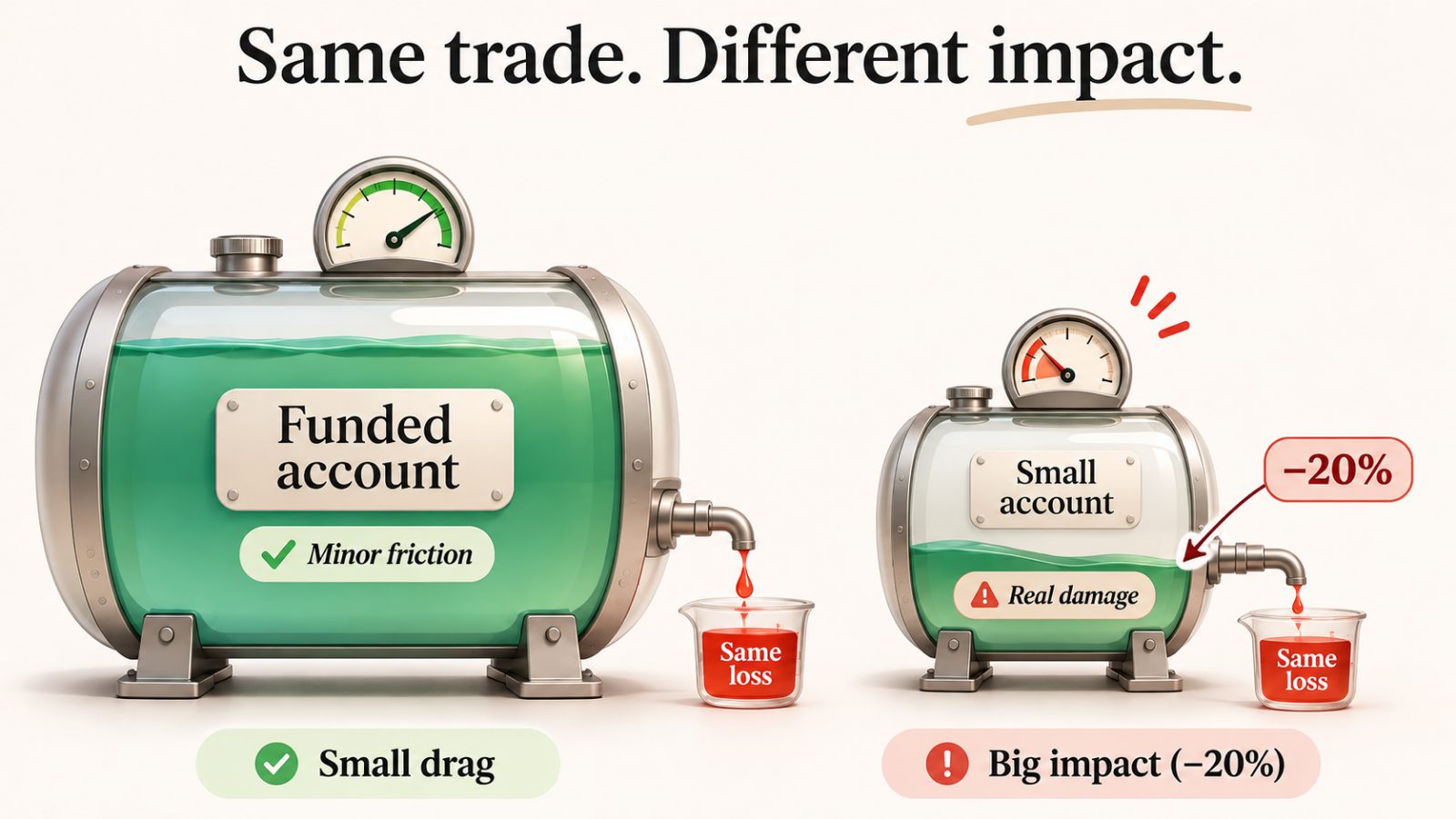
THE SAME CLICK, DIFFERENT PRICE
A mediocre trade costs a small account more than it costs a big one
Nobody tells you this out loud. The YouTube videos show funded traders taking ten setups a day because they can. Their edge absorbs the noise. A couple of random entries smeared across a real account is a rounding error in the monthly P&L.
Run the same trade frequency through a small account and the math inverts. Commissions become a percentage. Slippage becomes a percentage. Give-back on a stopped-out scalp becomes a percentage. The small account doesn't have the mass to flatten these out. Every unnecessary click is weighed against a base that can actually feel it.
The funded trader's bad habit is drag. Yours is a leak in the hull.
WHAT COMPOUNDING ACTUALLY ASKS
Compounding doesn't want more of you. It wants less.
This is the part that is counterintuitive and that nobody wants to hear on a slow Tuesday.
A small account only has one real path forward, and that path is compounding. Compound 2% a week and the curve starts to move. Compound 2% a week with three unnecessary scratch trades layered on top and the curve flattens, because you just spent your gain on commissions and the cognitive load of trades you didn't need to take.
Compounding doesn't need you to click more. It needs you to click less and stay still long enough for the math to matter.
The hard truth sitting underneath this: a small account doesn't ask you to be a better trader than the funded one. It asks you to be a more selective one. The funded trader can afford to be average on ten setups. You have to be excellent on two.
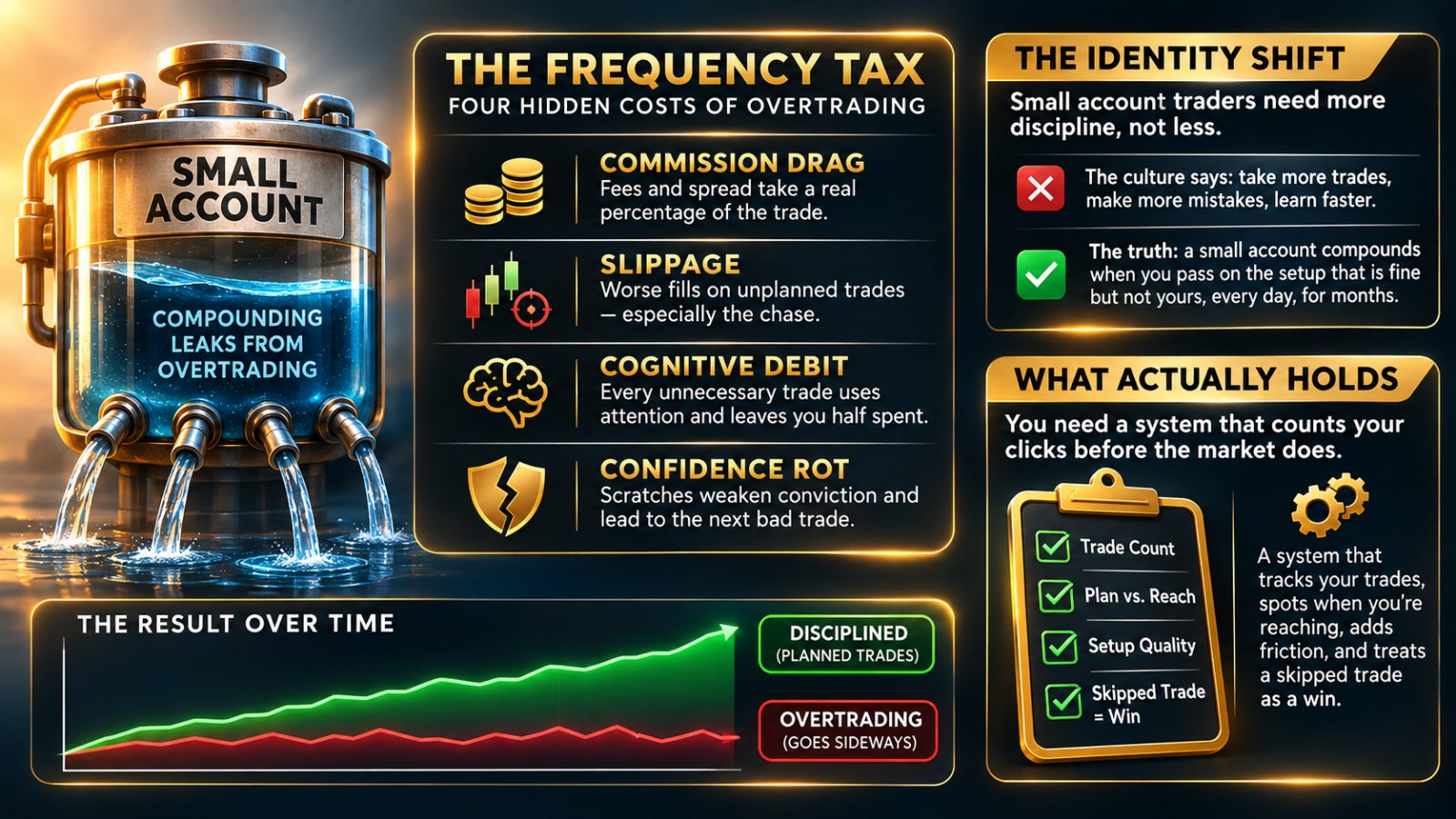
THE FREQUENCY TAX
Four taxes you don't see on the statement
The small account loses to overtrading in ways that never show up as a single big red number. They show up as a monthly curve that won't steepen no matter how right you are on the trades you planned.
- Commission drag. On a small clip, the bid/ask and fees are a real percentage of the trade's expected value. Take twelve of those a day and you've paid a toll your account can't recover from in winners alone.
- Slippage on the unplanned trade. The setups you reach for are always the ones with worse fills. You rarely slip on your A setup. You always slip on the chase.
- Cognitive debit. Every unnecessary trade uses the same attention budget as a real one. By the time your actual setup shows up at the back of the morning, you're half spent.
- Confidence rot. Scratching a trade you shouldn't have been in doesn't feel neutral. It feels like a near-miss. That feeling is what leads to the eleventh trade, the one that finally hurts.
None of these show up on the day. They show up on the month. Which is exactly why a small account can go sideways for a whole quarter while the trader insists their edge is working.
THE IDENTITY SHIFT
Small account traders need more discipline, not less
The culture tells you the opposite. The culture says small accounts are a training ground, a place to swing freely because the dollar amounts don't mean anything yet. Take more trades, make more mistakes, learn faster.
That advice kills small accounts. Not immediately. Slowly, which is worse, because you can't trace the death back to any single trade.
A small account is not a sandbox. It is a precision instrument that compounds if you leave it alone and leaks if you don't. The trader who grows one is not the trader who clicks the most. It is the trader who passes on the setup that was fine but not hers, every single day, for months, while her friends with bigger accounts take the same setup and get away with it.
That asymmetry is unfair. It is also the only way out.
WHAT ACTUALLY HOLDS
You need something that counts your clicks before the market does
Rules written on a napkin don't hold a small account together, because the napkin isn't watching when the third unnecessary trade of the morning starts to look like a real one. By the time you notice the pattern, you've already paid the tax for the month.
What holds is a system that knows what your account can actually afford. A system that counts how many trades you've taken against your plan, that notices when you're reaching, that puts friction between you and the setup that is fine but not yours. A system that treats a skipped trade as a win because on a small account, it is one.
That is the gap between knowing you should click less and actually clicking less. And that gap is exactly what MAKETZO is built to close, one trade, one skip, one honest count at a time.