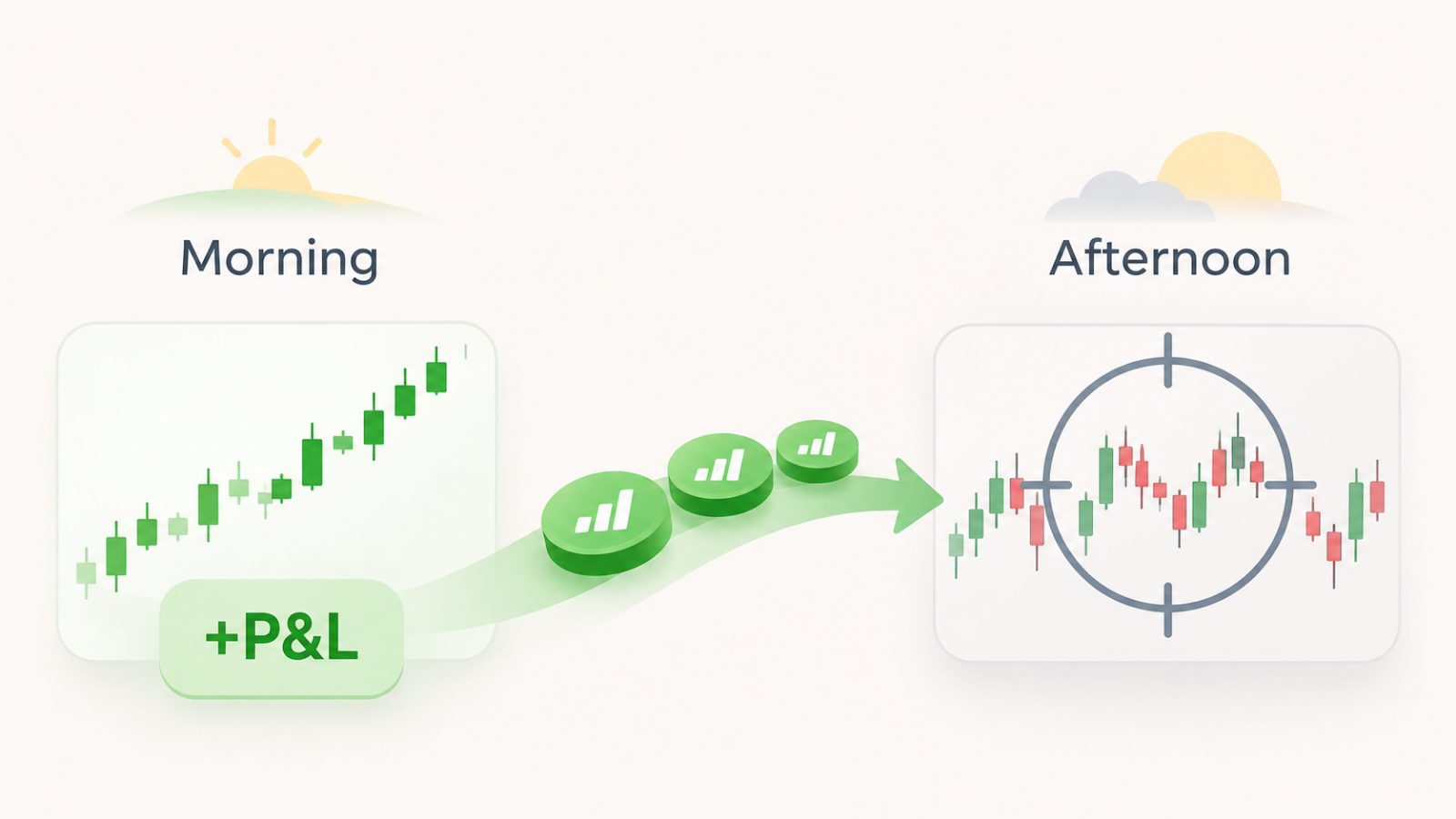
Nobody ever gives back a losing morning. The phrase doesn't exist. You can only give back something you had, and the only thing a trader has at the midday mark is the number on the P&L.
Which is where the problem starts. Because "giving back" is passive language for an active decision. It sounds like something the market does to you. It isn't. You go looking for trades you wouldn't have taken at the open with capital you didn't have at the open, and you call the result give-back so it doesn't feel like what it is.
It's hunting. You're hunting with the morning's money.
THE LANGUAGE
Give-back is a word that protects you from the truth
Think about how the sentence is built. "I gave it back." The subject is you, the verb is passive-ish, the object is an abstraction. Nothing in that sentence names a setup, a size, a session, a decision. It's the kind of sentence you'd use to describe losing an umbrella.
Now try the honest version. I took four trades between the lunch lull and the close. None of them were A setups. Two of them I wouldn't have taken at nine thirty with a flat account. I sized the last one bigger because I was annoyed the first three didn't work. That's not give-back. That's a second trading session you decided to run, funded entirely by the first one.
The reason the softer word survives is that it lets you keep thinking of the morning trader and the afternoon trader as the same person. They aren't.
THE SHIFT
The trader who booked the green is not the trader who shows up after lunch
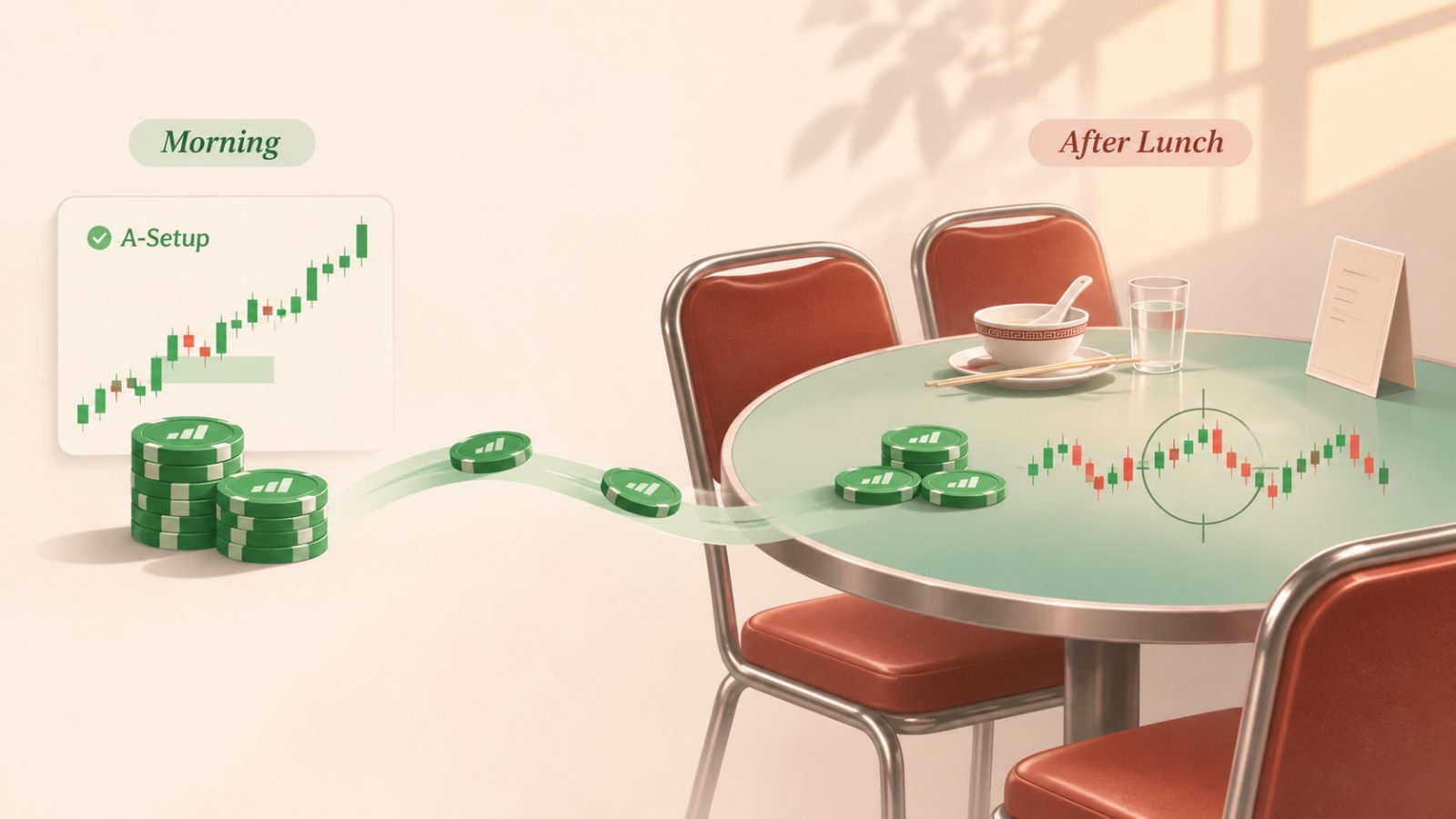
The morning trader was patient. He waited for his named setup, took it at planned size, and managed it without arguing. That's how the number got put on the board in the first place.
The afternoon trader is a different animal. He's tired. He's bored. He's a little proud. The screen has been on for four hours and his nervous system is coming down off whatever it was up on when the trade worked. He's not hunting for the same setup. He's hunting for a feeling, which is not the same thing, and the feeling he's chasing is the one he had around ten o'clock when it all clicked.
The afternoon trader doesn't want another trade. He wants another dose of the morning.
You cannot execute a plan written by the morning trader if the person at the keyboard after lunch is a different animal with different chemistry. And he always is. The question is only whether you planned for him or pretended he wouldn't show up.
THE CHEMISTRY
House money is a story your brain tells to loosen your rules
Up six hundred, the brain does something fast and quiet. It splits the account into two piles. The old pile, the one you walked in with, is still yours. The new pile, the six hundred, is something else. Bonus. Found. Not quite real yet. House money.
That split is a hallucination. The broker doesn't see two piles. Your spouse doesn't see two piles. Only you see two piles, and only for a few hours, and only so you can take a trade with the new pile that you'd never take with the old one.
Watch what happens to your sizing when the split appears:
- Size creeps up, because you're "only risking the gains."
- Setups loosen, because the downside has a cushion.
- Time horizon shortens, because you want the dose fast.
- The "one more" trade stops needing a reason beyond availability.
Every one of those shifts is a decision the morning trader never authorized. He wrote a plan for his money. The afternoon trader is running a different plan with what he's decided isn't really his money, which is why none of the rules apply.
THE FATIGUE
You are not tired of trading. You are tired of waiting.
By the time the midday grind sets in, the fatigue you feel isn't physical. It's the specific exhaustion of sitting still on an account that already did its job. The screen is still moving. Something is always setting up somewhere. The hardest part of the afternoon isn't finding a trade. It's accepting that the day is over and you have nothing left to do but close the laptop.
Nobody teaches you to close the laptop. The platforms are designed to keep you in the seat. Your group chat is still going. The market is still open for hours. And so you confuse "the session is open" with "I should be trading," and the next thing you know you're sizing into a B minus setup because at least it will end the waiting.
That trade is not an edge expression. It's a boredom expression, funded by the morning, disguised as participation.
THE FIX
Close the day on purpose, not by accident
The traders who keep their mornings do a thing that looks almost too simple. They define, before the bell, what closes the day. Not just a daily loss limit. A daily green limit. A number, a time, a trade count, a setup quality bar. Something that lets the morning trader write a contract the afternoon trader has to honor.
Some versions that work:
- A profit-stop number. Hit it, flatten, walk.
- A trade-count cap for the back half of the session.
- A rule that says any afternoon entry must be an A setup and must be journaled before it's taken.
- A hard physical reset at the midday mark. Stand up, leave the room, come back only if there's a named reason to.
None of these are clever. All of them do the same thing: they take the authority to deploy the morning's capital out of the hands of the afternoon trader and keep it with the person who earned it.
A green day is not something you survive. It's something you decide to end.
The trader who can't end his green day is the trader whose green days become red ones, over and over, in a pattern he describes as unlucky. It isn't unlucky. It's unenforced.
What you actually need
You don't need more willpower in the afternoon. The afternoon trader has less of it than the morning trader by biology, and no amount of resolve written in Evernote at the open will survive the chemistry of a four-hour session and a soft lunch.
What you need is a system that holds the line for you. A pre-committed set of session rules the platform enforces before your afternoon self can override them. A log that flags the quality drift in your entries before you've taken four of them. Something that notices you've shifted from your A setup to something that just looks like it, and says so, out loud, before the click.
That is the thing MAKETZO is built to be. Not a coach that lectures you after the damage. A pre-commitment layer that sits between the morning trader who earned the number and the afternoon trader who's about to hunt with it. If closing your own green days has been the problem, that's the problem it was built to solve.