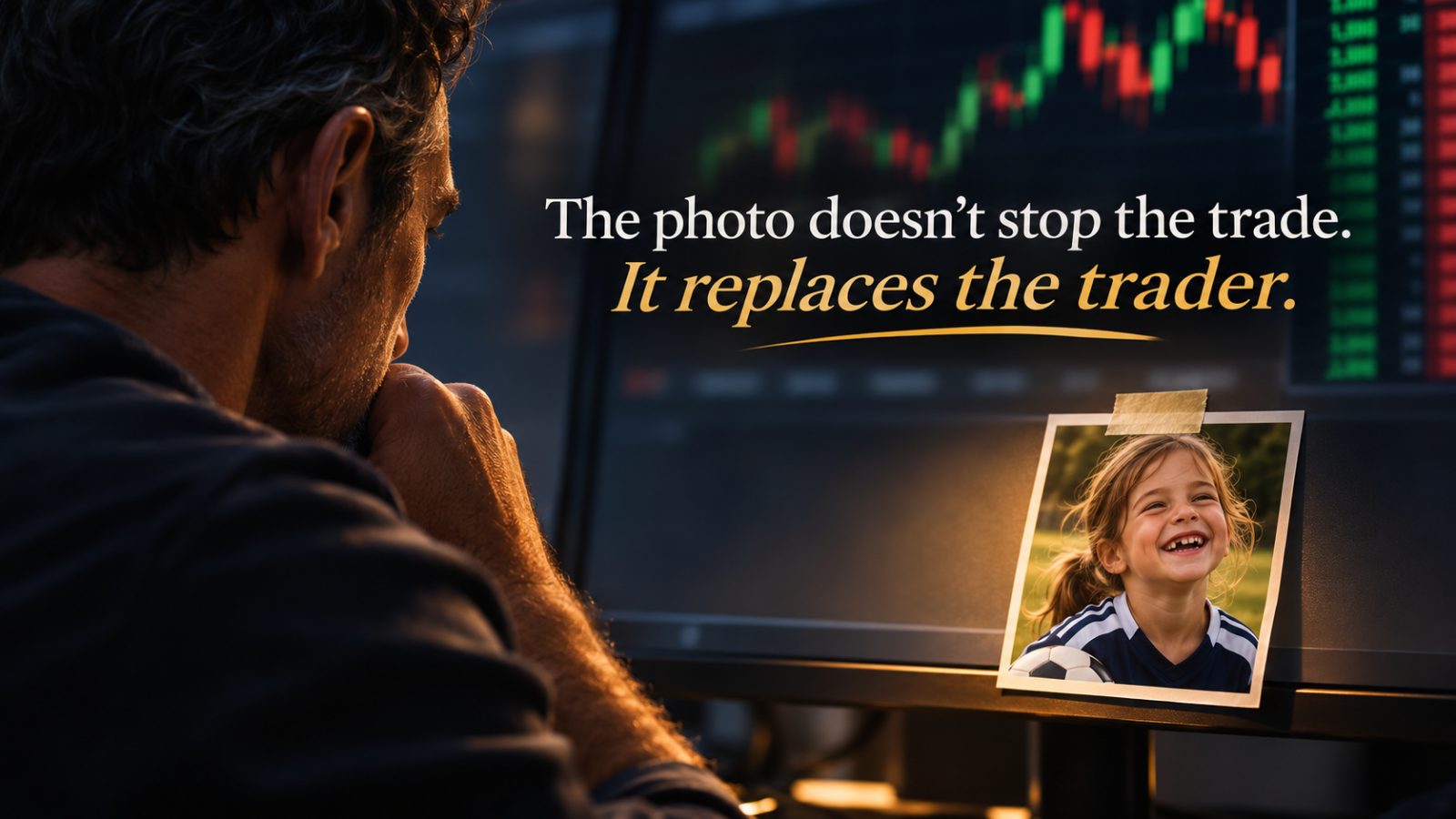
A trader I know has three monitors. On the middle one, taped right under the Level 2 ladder, is a photograph of his daughter at a soccer game. She's six. Mid-laugh. One front tooth gone. He told me, over a beer, that the photo has stopped him from clicking buy more times than any rule he has ever written down.
I asked him why he thought that worked, because he's a serious person and he knew the rules he kept breaking. He wrote them. He agreed with them. He had read every book. None of that mattered in the moment. The photograph mattered. He didn't know why. That's the piece I want to explain, because the mechanism is not what traders think it is, and knowing the mechanism is the difference between a photo that works and a photo that becomes wallpaper.
THE SUNDAY WRITER
The rule didn't fail. Someone else showed up.
Your trading rules were written by a specific person. That person had coffee, slept well, hadn't taken a loss in sixteen hours, and was sitting on the couch with a notebook on a Sunday afternoon. Call him the Sunday Writer. He is thoughtful, cautious, and correct about almost everything.
The Sunday Writer is not the one at the desk when a small cap runs twelve percent against your stop in forty seconds. The person at the desk is a different human being, running on different chemistry, with a different nervous system and a narrower set of available thoughts. Call him the Tuesday Trader. The Tuesday Trader has read your rules. The Tuesday Trader does not care about your rules. The rules were written for someone he no longer is.
This is not a failure of discipline. It is a failure of who you were counting on to enforce it. Every written rule is a message from one version of you to a later version, and the later version does not always open the mail.
WHAT THE PHOTO DOES
It doesn't remind you of the rule. It swaps out the person.
Here is the thing nobody says plainly about anchor images. The photograph on the monitor is not a reminder. A reminder would be a sticky note with your max loss on it. A reminder talks to the Tuesday Trader and asks him nicely to behave. He won't.
The photograph does something stranger. It pulls a different identity into the chair. You cannot be a father and a revenge trader in the same second. The roles are incompatible. The father does not click buy to prove the market wrong. The father clicks buy to pay for a kitchen remodel, a summer camp, a quiet retirement that doesn't require one more red Friday.
The rule talks to the trader. The photo talks to the father. Only one of them is still in the room.
When you look at the photo, for one second, the father is in the chair instead of the Tuesday Trader. The father makes a different decision. That's the whole trick. You are not winning an argument with yourself. You are changing which self is answering.

THE NEUROSCIENCE, QUICKLY
Rules are verbal. Your brain under stress isn't.
Written rules live in the language areas of the brain. Those areas sit in the prefrontal cortex, which is the part that goes offline first when cortisol spikes. Under stress, the system that reads your rules is the system that stops working. That's not metaphor. That's architecture.
Images do not use that pathway. A face, especially a familiar face, is processed in a much older, deeper part of the brain. That system does not need language and it does not need bandwidth. It fires even when the prefrontal cortex has gone dark. It is, conveniently, the same system that is currently hijacking you into the next trade.
You cannot out-think a limbic hijack with a prefrontal argument. You can only meet a limbic signal with a stronger limbic signal. A photograph of someone you love is one of the few things in the world that qualifies. It is not sentimentality. It is the correct tool for the specific system that is currently driving the car.
WHAT ACTUALLY GOES IN THE FRAME
Most anchor images don't work. Here's why.
If you've tried this and it didn't stick, the problem is almost never commitment. It is almost always the picture.
- It has to be a person, not a thing. A photograph of the boat you want does not look back at you. A face does. The identity swap needs eyes.
- It has to be candid, not posed. A studio family portrait is a stranger in matching sweaters. A blurry phone shot of your kid eating pancakes with her hair in her face is the actual person you are trading for. The difference matters.
- It has to be printed. A photo on your phone requires you to pick up your phone, which means you have already left the chair in your mind. The image must be inside your trading field of view, already visible, with no friction to see it.
- It cannot be the same image forever. The brain stops registering a constant stimulus. Rotate the photo every few months before it becomes wallpaper.
- It needs a trigger moment, not ambient exposure. Glancing at the photo all day does nothing. Forcing yourself to look at it for ten full seconds before any trade you weren't planning is where the switch happens.
That last one is where most traders lose the thread. The photo isn't a vibe you absorb across the morning. It's a stop sign at a specific intersection. The intersection is the second between the impulse and the click, and the sign only works if you actually stop at it.
THE RITUAL AROUND IT
A photo without a pause is decoration.
The research on pre-commitment, going back decades, is boring and consistent. The thing that keeps people on plan is not willpower, information, or consequences. It is a small physical ritual, performed in the moment of temptation, that was designed when the person was calm.
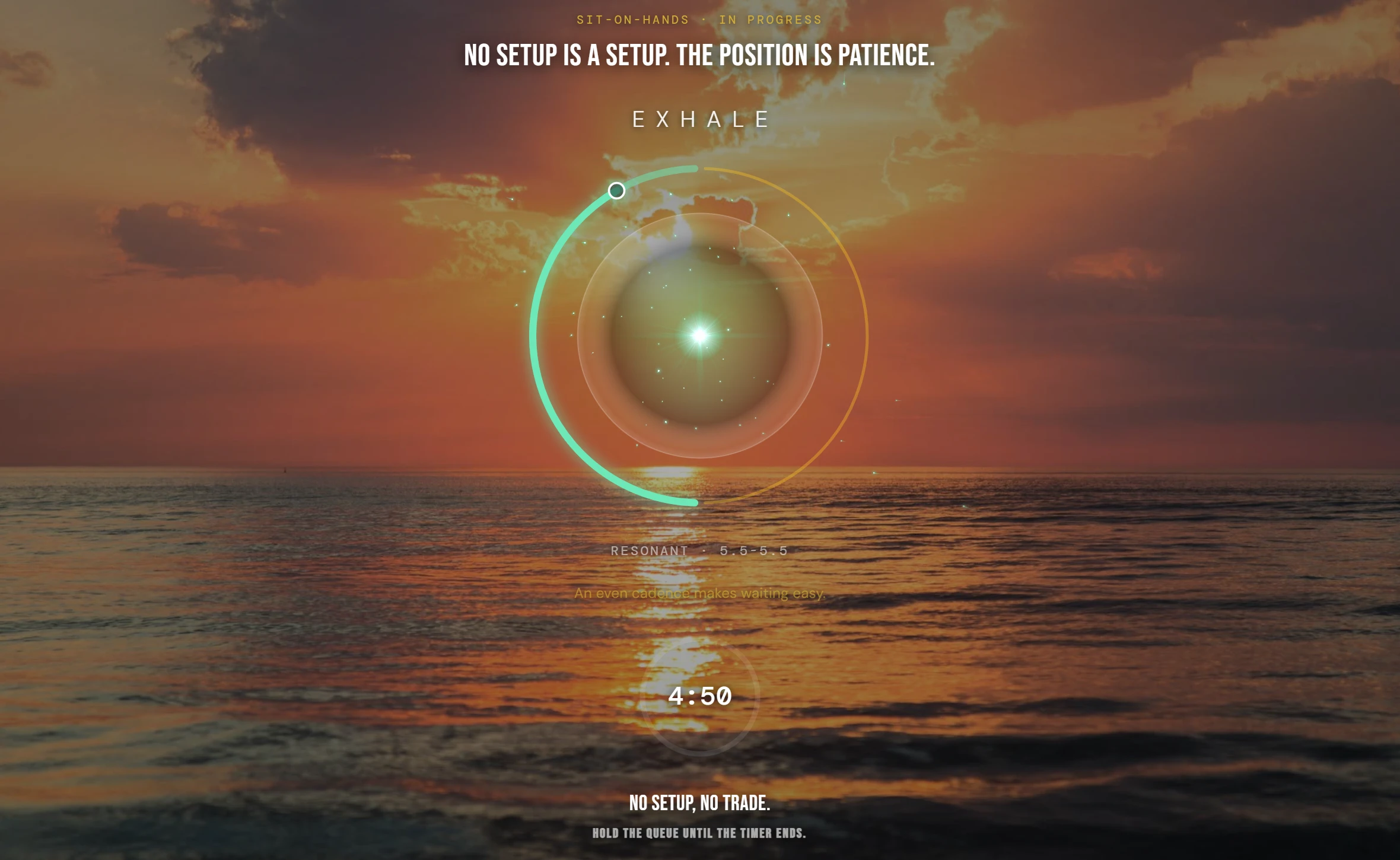
The photograph is half of that ritual. The other half is what you do while you look at it. Three slow breaths. One sentence said out loud, usually something like I am not trading this one or I already decided this was a skip. Then you look at the chart again, and the trade is either still there in a form you recognize, or it isn't. Most of the time, it isn't. The second it took to run the ritual was the second the Tuesday Trader needed to step out of the chair.
If you want to rig this for yourself, the simplest version of the Loss Reset is already built into MAKETZO. Three minutes of paced breathing, a photograph of what you actually trade for, and one written promise before the next trade is allowed. It is boring on purpose. It is the father's ritual, not the trader's, which is the entire point.
Your rules will not stop you on your worst day. The person who wrote them is on the couch. The person at the desk doesn't know him. But the father at the desk knows the girl in the photograph, and the father is not going to click.