Count the Months of Cash First
A company with four months of cash is going to raise money, and for most small caps, selling stock is the raise.
Take the latest 10-Q and divide cash by operating burn. Six million dollars of cash against $4 million of burn per quarter is about 4.5 months. A business losing money at that pace has to raise before the year is out, and it would rather do it on a green day than a red one.
Two details change how you read that number.
- The date. Smaller companies get 45 days after a quarter ends to file a 10-Q, so the cash figure can be weeks old the first time you see it. It describes the last day of the quarter and nothing since.
- The words "going concern." When that phrase shows up in a filing, the company is telling you it may not have enough money to last a year.
Then ask what a spike does for that company. A stock up 60% on news can sell shares at a price it could not have had last week. A few months of cash plus a spike is an offering setup until the filings say otherwise.
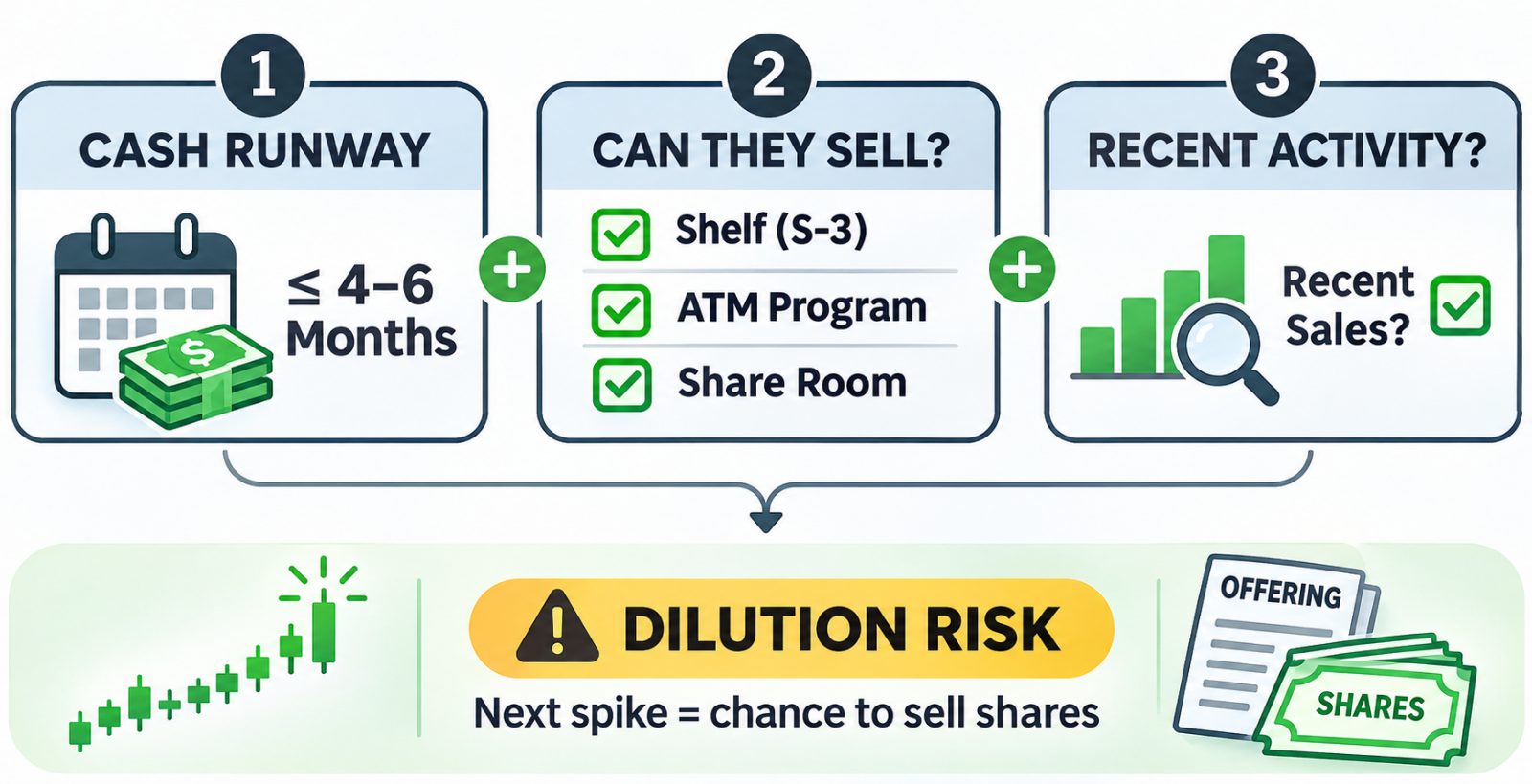
Find Out Whether the Company Can Sell Today
Cash tells you the company needs to sell. The next question is whether it can do so this morning.
- An effective shelf. A Form S-3 clears a pool of stock to sell in pieces for up to three years. The shelf sells nothing by itself. A fresh S-3 filed as a stock starts running is the company clearing room.
- An at-the-market program. The company sells into the market at the going price through a sales agent, with no announcement for each sale. Capacity sits in the prospectus, and the amount sold shows up in the 10-Q. Heavy volume and a stalling price with no news is often this program at work.
- Room under the authorized count. Authorized shares are the ceiling in the charter. A wide gap over the outstanding count is headroom. A company near its ceiling has to ask shareholders for more, and that proxy request tells you what comes next.
Smaller names carry one more piece of arithmetic. A company with under $75 million of public float can sell only one-third of that float off its shelf in any 12 months, and the float is priced as of a date within the 60 days before the sale. So a spike can raise the cap. With 10 million shares owned by outsiders at $1.50, the limit is $5 million, minus what the company sold in the prior 12 months. At $3.00 the same calculation allows $10 million.
The SEC proposed eliminating this limit in May 2026. Find out whether that has become final before you lean on the math.
Read the Habit, Not the History
Almost every small cap has sold stock at some point, so old history separates nothing. An open channel and a recent sale do.
Three sales in twelve months is a company that funds itself this way. One sale two years ago on the same shelf is a company that has the option and has not used it.
Pull the share count off the cover of the last four 10-Qs, where every filer has to state it. A path from 20 million to 60 million to 120 million shares, adjusted for any reverse split, shows a business that pays its bills by issuing stock. It also means a chart level from the 20 million share days was set by a different stock.
Then add the supply that has not reached the chart yet.
- Warrants and pre-funded warrants can become stock without the company filing anything new.
- Unit deals carry two waves: the shares now and the warrant shares later if price reaches the strike.
- Convertible notes with a fixed conversion price are overhang you can measure. A note that converts at a discount to the market hands the lender more shares as the price falls, and that is a reason to stay out entirely.
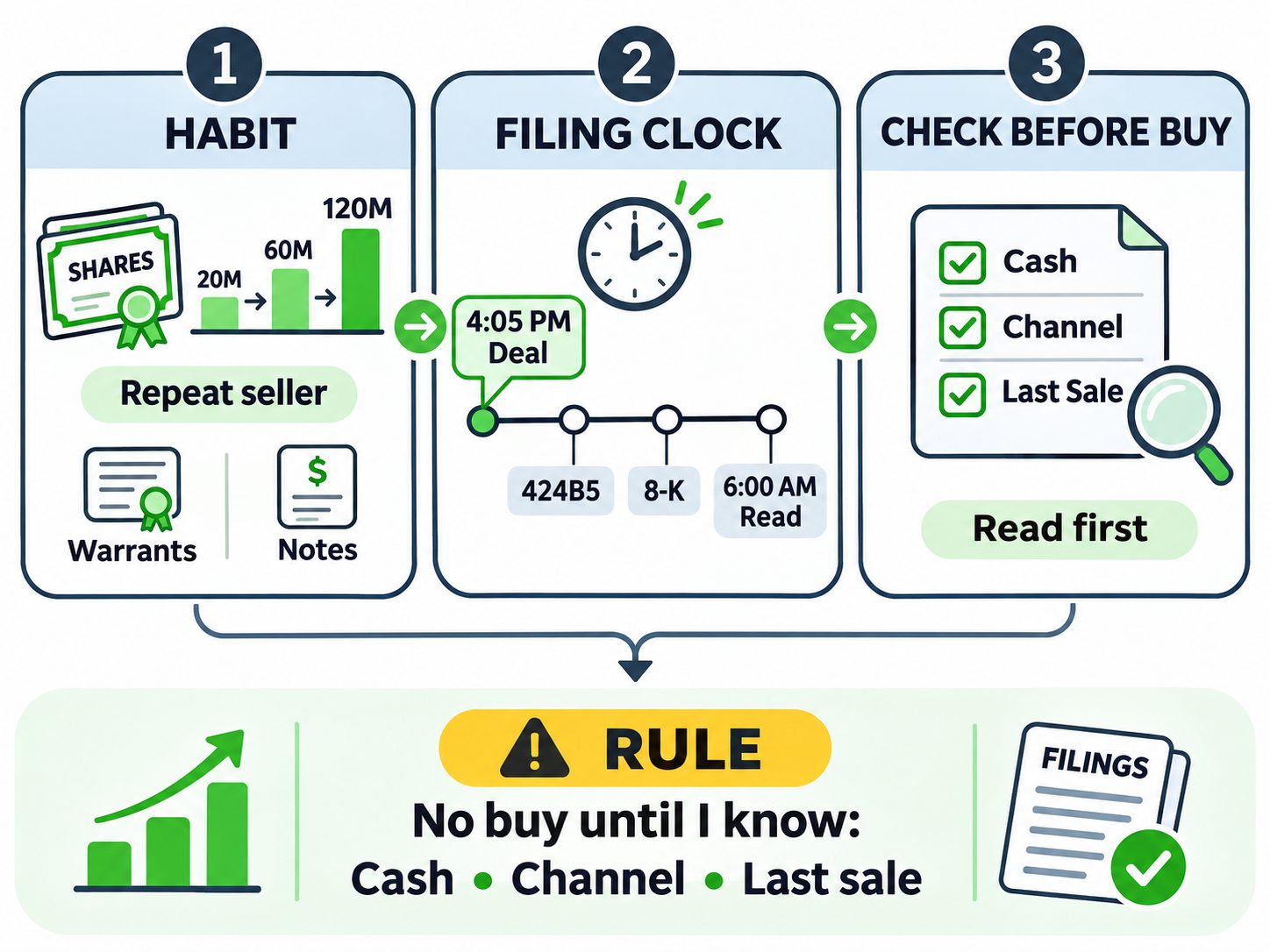
Watch the Filing Clock Around a Deal
A deal usually reaches the tape before its filing reaches EDGAR, so learn the order they arrive in.
At 4:05 p.m. a company announces a registered direct priced under the close. The funds buying it paid less than the last price, and they can sell into you at 9:30. The documents come afterward.
- The prospectus supplement, Form 424B5. Due by the second business day after the price is set.
- Form 8-K. Due within four business days of the event. Look for Item 1.01 for a material agreement and Item 3.02 for an unregistered sale of stock.
- Anything sent to EDGAR after 5:30 p.m. Most of it stays unpublished until 6:00 a.m. the next business day, which makes 6:00 a.m. your first useful read of last night's deal.
One 8-K gives earlier warning. Item 3.01 reports a listing deficiency, and a Nasdaq stock under a dollar that gets one usually reaches for a reverse split or a raise. The tape tends to sell both, and the split clears authorized room for the next offering.
Run the Check While the Name Is Still a Symbol
Do the reading before you like the stock. Once you are interested, reading turns into looking for permission.
To see all of it on one card, run the ticker through MAKETZO's stock dilution check. It reads the company's SEC filings, gives a supply risk from low to high, and shows whether a selling channel is open, how recently the company used one and what cash is left against its burn.
- Read the sentence under the verdict. "They sold stock 26 days ago and the channel is still open" tells you more than the word HIGH.
- Treat LOW as a statement about filings. It does not grade the stock, which is why the card never shows green.
- Treat unknown as unknown. When a number could not be confirmed, the card says so instead of guessing.
- Open one filing. Clicking through once to the actual 424B5 turns a card you believe into a card you checked.
No filing reader can see a deal that has been negotiated and not filed yet, so a clean card leaves that risk open.
Write one rule you can answer yes or no: I do not buy a spike in a small cap until I know its months of cash, its selling channel and its last sale.
MAKETZO is a trading discipline system for small cap day traders. COACH SAYS coaches you in real time when your behavior drifts from the rules you set, the Focus Room is where you reset after a fade catches you, and the journal grades discipline on every trade. Every plan starts with a 7-day free trial, and MAKETZO never gives stock picks or financial advice.