Why Your Journal Can Teach You the Wrong Lesson

The better a trade paid, the less you should trust your memory of why you took it. Build your journal around that rule of thumb, because most journals are built as if memory were reliable.
Every trader hears the same starter advice: log the ticker, entry price, exit price, shares, P&L, setup and how you felt, then read it all back on the weekend. All of that is worth writing down. It still leaves two holes, and on a small cap those two holes get expensive.
The money sits beside the judgment. Take two trades from one morning. The first is a setup you wrote down before the bell, and you cut it at your line for a loss. The second is a stock you had never looked at, bought because it came off a halt and the chat room got loud, and it pays. Sort that morning by P&L and the second trade looks like the better one. Your memory files it the same way.
Researchers call this outcome bias. In a 2023 replication of a classic 1988 experiment, 692 people judged the same medical decision. Those told it had worked rated the decision higher than those told it had failed, and the gap showed up even among people who said results should not count. You read your own trades with that same bias, and a P&L column feeds it.
The reason gets written after the ending is known. Many logs get completed after the close. By then you know which trades paid, so the winners look obvious and the losers collect excuses. A reason written at 4 p.m. describes a trade whose ending you already know, so it tells you nothing about how you decided at 9:41.
Both fixes are free. Before each order goes in, write one line: the setup and why it qualifies today. At the close, answer your rules before you open your P&L. Do that for a week, then compare what you wrote before each order with what you remember about it.
What to Log in a Trading Journal, in the Order You Know It
Log things in the order you learn them. A flat template lets you write the reason last, after you already know how the trade ended. Split the same fields by when you know them and the record gets harder to rewrite.
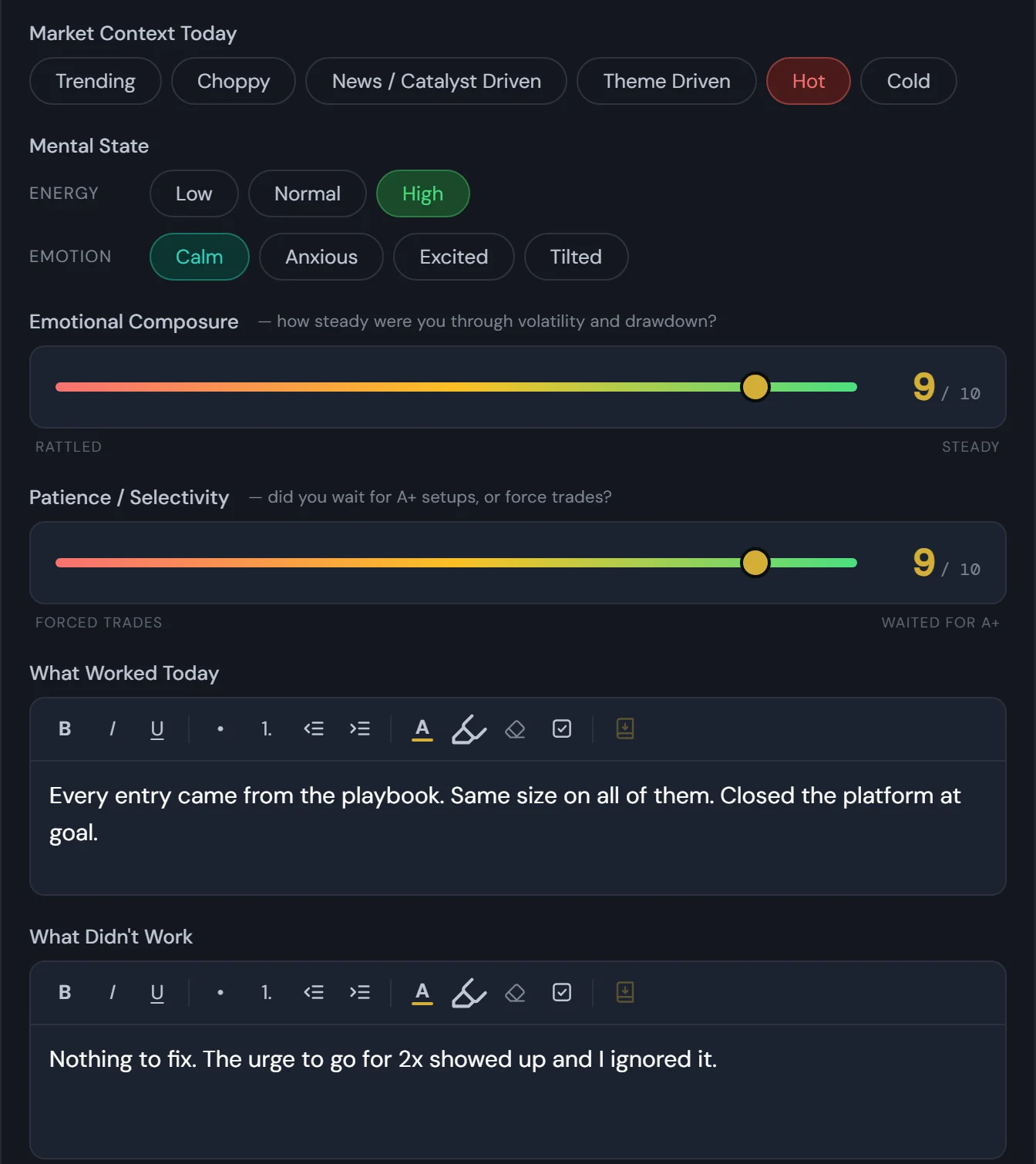
Before the bell
- Your rules for today, each one answerable Followed or Broke
- What ends your morning, in your own numbers for your own account
- Your market read and your energy, one word each
- The tickers on your list and what has to happen for each to become a trade
Before each order
- The setup name
- One line on why this setup qualifies right now
- The price that proves you wrong
After each exit
- Ticker, time in, time out, shares, entry price, exit price and P&L after fees
- The price you meant to get and the price you got
- The rule you kept or broke on this trade
At the close, in this order
- Answer each rule: Followed, Broke or N/A
- Rate your composure and your patience
- Write one thing to repeat and one thing to fix
- Name one focus for tomorrow
- Only now, read the day's P&L
One test for every rule on your list: if you cannot mark it Followed or Broke at the close, rewrite it until you can.
If a full page is the reason you quit last time, cut it down to the ticker, setup, one-line reason, P&L and rule answers. One honest line beats a blank page, and a record you finish every day teaches more than a thorough one you abandon by March.
Fields a Small Cap Day Trader Has to Add
A small cap trade turns on two things a generic log rarely asks about: how many shares are available and whether the company can sell more. Those two shape how the trade behaves, so give them columns, along with the rest of this list.
- Float at entry. Write it in buckets you choose tonight, before you have results to fit them to. Sorting by bucket later shows which kind of stock you read well.
- Catalyst. News, earnings, a filing or nothing at all. No news is a category of its own, so log it as one.
- Minutes since the open. Write 9:41 as 11. A setup that works at minute 5 and fails at minute 90 looks average until you split it.
- Halts. Note whether the stock halted while you were in it and whether you entered on a reopen. Those trades should not share an average with the rest.
- Spread at entry. On a thin name, the gap between bid and ask is a cost you pay going in and coming out, and a setup can look fine on the chart while losing money to it.
- Supply. Can the company sell stock into this run, and has it been doing so?
Before you trade a runner, look the company up in Dilution Check. It reads the SEC filings and gives you a supply risk from low to high, plus three facts for your log: whether the company can sell stock right now, how often it sold in the past twelve months and how long its cash lasts. If a fact could not be confirmed, write unknown, because unknown is not the same as no. The card reports what has been filed and leaves the decision to you.
Add these columns and set your float buckets before tomorrow's open. Give any bucket a few dozen trades before you believe it, because one week is too small to read.
How to Review Your Journal and Change Your Next Open
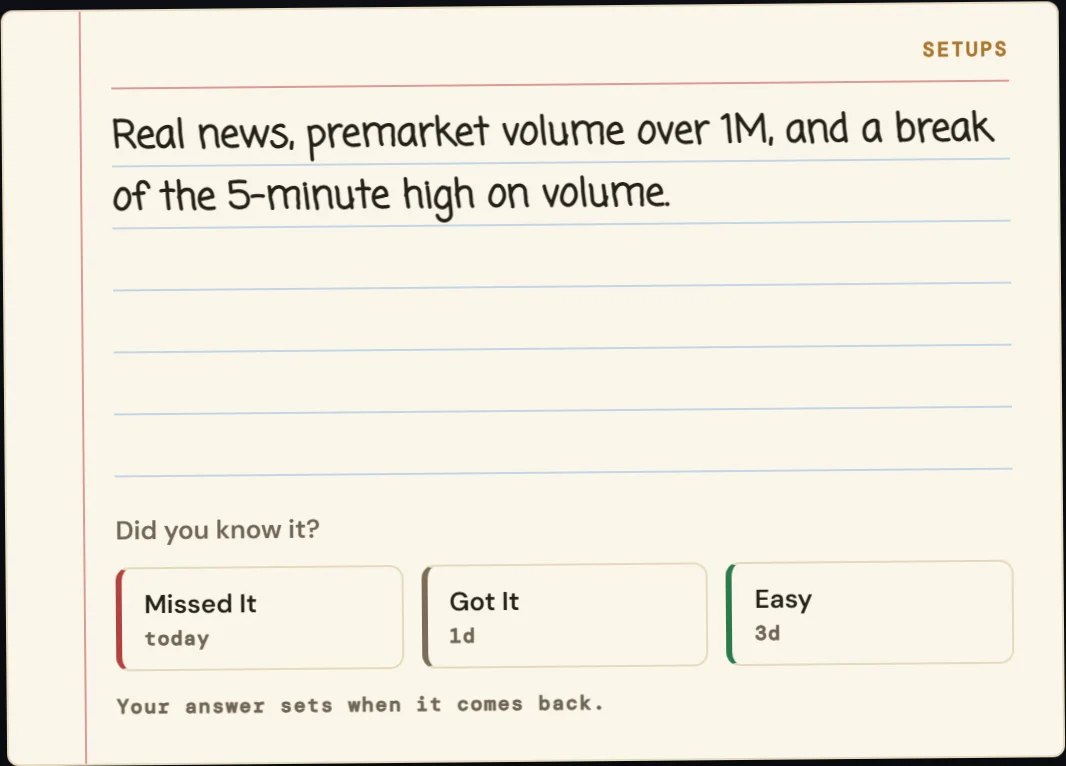
If a review does not change what you do at the next open, all you did was reread your trades. At each close, sort the day into one of four boxes, using the rule answers first and the money second.
- Green, rules kept. Repeat it, and name what made it possible.
- Green, rules broken. Read this day first. The money says it was fine, and that is how the habit survives.
- Red, rules kept. A good day that cost money. Leave the plan alone.
- Red, rules broken. Find the first broken rule of the morning. The last one shows the damage, and the first one shows the cause.
Once a week, count three things: green days with a broken rule, the clock time of each day's first broken rule, and what happened in the five minutes before it. If the first break keeps landing right after your first loss, you have found the exact minute to plan for.
Then read one number, your average win against your average loss. A high win rate with that ratio under 1 means your winners are smaller than your losers, and the win rate hides it.
Turn the finding into one if-then rule: "If I take a loss, then I read my rules and wait for a setup that was on my list." A review of 642 tests found plans in that if-then form improved what people thought, felt and did. It was not a study of traders, so treat it as a strong hint. Test one rule for two weeks before you add another.
Free Trading Journal Template, and When to Pay for Software
You can start tonight for nothing. Make one spreadsheet column for each of these: Date, Ticker, Minutes Since Open, Float Bucket, Catalyst, Supply, Halted, Setup, Reason Before Order, Time In, Time Out, Shares, Entry Price, Exit Price, Expected Price, P&L After Fees, Rule Kept or Broken, Note. Add a second tab with one row per day for your rules, your four-box result and your focus for tomorrow.
Three formats can carry those fields, and each one fails differently.
- Notebook. Fastest to write and easy to keep beside the keyboard. You cannot sort it, so it will never tell you which float bucket costs you money.
- Spreadsheet. Free, sortable and entirely yours. You build and maintain it, and typing partial fills by hand after a busy morning is the chore that makes traders quit.
- Software. Imports your trades and builds the reports. It costs money, and the import only helps if it reads the platform you execute on.
Pay when typing is what makes you skip days, and not before. Try any paid tool on real sessions, and find out how to get your records back out before you commit. For side-by-side reads of two popular options, see our Tradervue comparison and our TradeZella comparison.
What a Journal Cannot Do, and What MAKETZO Adds
A notebook, a spreadsheet and journal software share one limit: each can only read a trade that already happened, and the expensive decision gets made in the seconds before the order. You can measure that gap yourself: tomorrow, note the clock time of your first urge to break a rule and what you did in the next sixty seconds. If nothing on your screen spoke up in those sixty seconds, your journal could only tell you about it afterward.
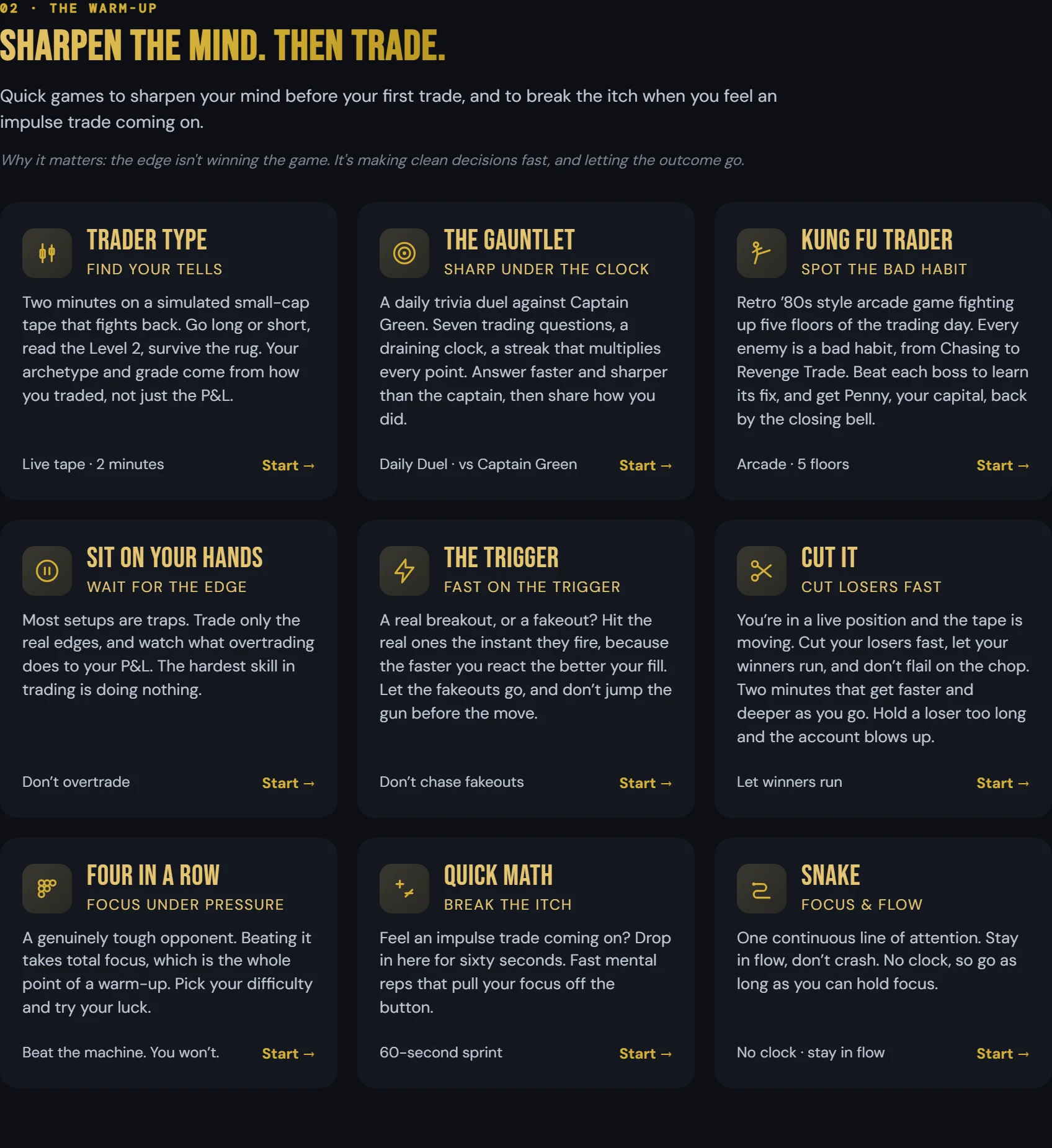
MAKETZO is a trading discipline system for small cap day traders, and its journal is one part of it. The idea is to set your rules when you are calm and have them enforced when you are not.
- Each morning, the Morning Lock-In has you commit to the day's rules before any money is on the line.
- During the session, the Strike System and COACH SAYS catch the drift from those rules with a direct message, right when you want back into the stock that just cost you.
- When you tilt, the Focus Room gives you a reset to run in place of the next trade.
The journal then grades your process separately from the money. Your Picard Score is a daily grade from 1 to 10 of how you ran your process, scored independently of your P&L, and the biggest part is whether you followed your rules and your contract. A 9 to 10 reads Ran It Clean, 7 to 8.9 Held the Line, 5 to 6.9 Drifted and under 5 Broke the Plan.
Sign Off on Today makes the score final, so a bad morning cannot be graded up that night. Editing a past day later saves your notes and shows the edit, and the grade does not change. Your Focus for Tomorrow comes back the next morning, and the journal asks whether you honored it.
Imports come from DAS Trader only. Upload your DAS file and each reconciled day carries a DAS Verified badge, exact to the cent. Type your net P&L yourself and the day shows Manual Estimate, and the accountability side and your Picard Score still work. Every plan starts with a 7-day free trial, and the options are on the pricing page. MAKETZO teaches and keeps you accountable. It never gives stock picks or financial advice.
Common Questions
Are trading journals effective?
They can be, but the proof is thinner than the marketing suggests. We looked for a controlled study showing that keeping a journal raises retail traders' returns and did not find one, and the numbers you will see mostly come from companies selling journals. What a journal can do is show you which rule you break and when, and the change still has to come from you. Test yours after 30 days by asking one thing: is the rule you break most getting broken less often?
What is the best free trading journal?
For an active small cap day trader, usually a spreadsheet, because you can give float, catalyst and supply their own columns. Free plans from journal companies tend to limit imports or features, so check those limits against how many trades you take in a week. A spreadsheet leaves the reports to you, so set aside ten minutes a week to sort by float bucket and time of day.
How often should I review my trading journal?
Five minutes at every close and a longer sit-down once a week. The daily review is for rules: which ones you kept and which you broke. The weekly review is for patterns, such as the time of day your first broken rule lands. Wait for a few dozen trades before you change a setup, since a single week is too small to read.
Photo by Clay Banks on Unsplash · Photo by Brett Jordan on Unsplash