Sort Your Mistakes by How Often You Tag Them
Open your log and sort your mistake tags by how often you have used them.
There it is. Chased the entry. Moved the stop. Back in after a loss. It has dates, screenshots and a running total at the bottom of the column.
You named that mistake months ago. You wrote a paragraph about it. You tagged it again this week, in nearly the same words.
A trader who has tagged the same mistake dozens of times does not have an information problem. You know what you do, when you do it and what it costs, and you can prove it with a chart.
So what has all that review actually been doing for you?

You Are Not Reviewing Your Mistakes. You Are Archiving Them.
A record of a mistake is not a correction of it.
The first advice every new trader hears is to track everything, because the data will tell you what to fix. That is half right, and the missing half is expensive. Data can tell you what to fix. It has no way of making you fix it.
Good software makes the trap more comfortable. Tradervue does its job well: it imports your executions, groups them into trades and breaks them down by instrument, day, tag and time. The trouble is what you expect from all that. After a hard week, an hour in the reports feels like work. It looks like work. And when you close the tab, nothing about your next morning has changed.
There is research on why. In 1996, Avraham Kluger and Angelo DeNisi pooled the studies on what feedback does to performance. Feedback helped on average, and more than one third of the interventions made performance worse.[1] Their explanation is the part to keep: feedback loses its force as attention shifts away from the task and toward the self. Those studies were not about traders, but you know that shift. You open the report to find out what to do differently, and you close it knowing you are a bad afternoon trader.
So change the grammar of your review before tomorrow's open. Ban any sentence that starts with "I am." "I am impatient" is a verdict on you, and there is nothing to do with a verdict. "I bought three cents past my level after it had already run" is something your hand did, and your hand can stop doing it.
The Four Seconds Your Report Can't See
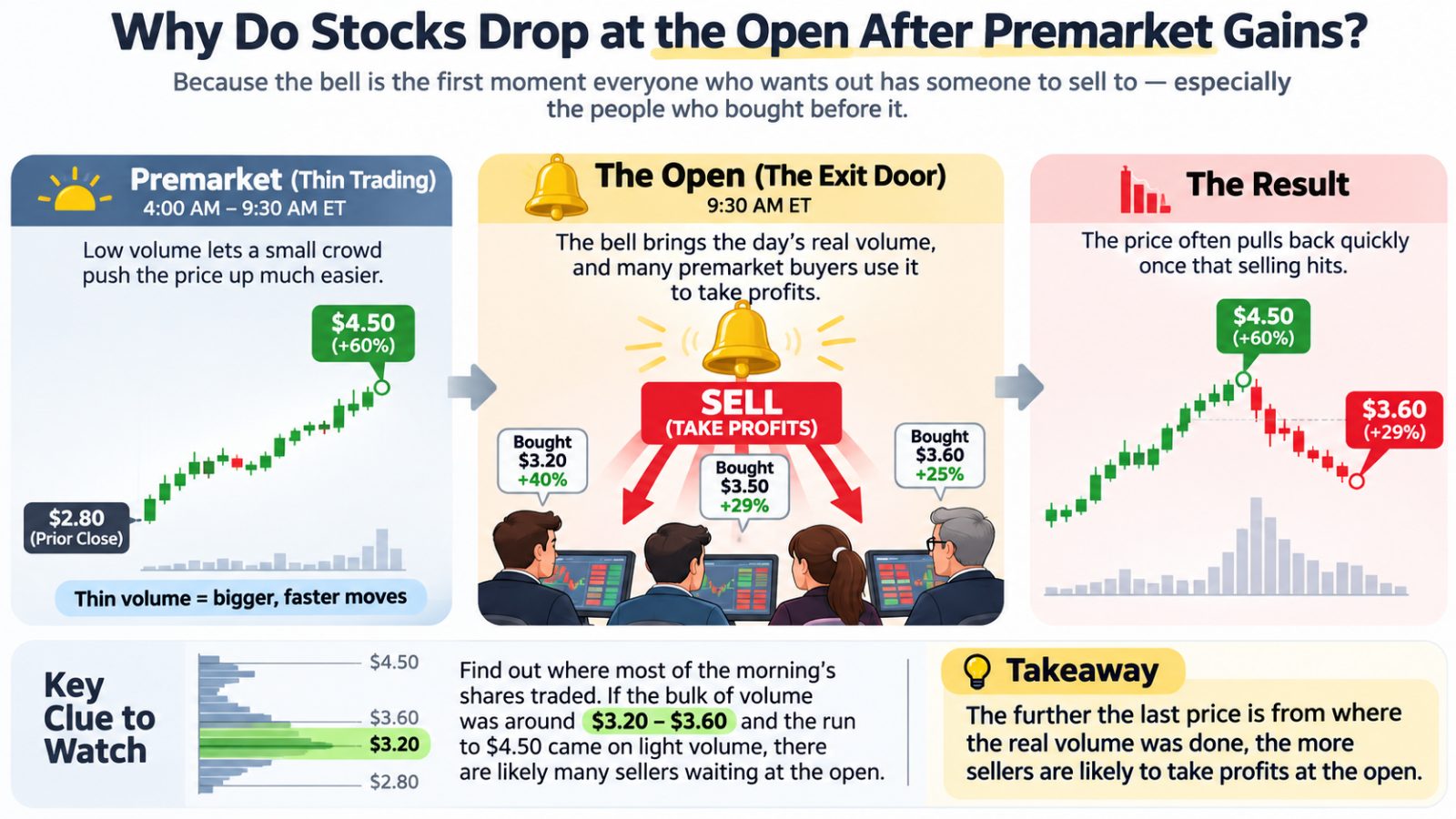
Every report you own starts after the only four seconds that mattered.
Sunday night you read the whole month, and the pattern is obvious: your late-morning trades give back what your opening trades made. You write the fix in capitals. NO TRADES AFTER THE FIRST HOUR.
Monday goes fine.
Tuesday you are green, the tape has gone quiet, and the screen is still on. A name you have never heard of starts running on a headline. You know the rule. You can see the rule, because you wrote it in capitals. Then a sentence arrives in your own voice: this one is different, it has news.
Look at who is in the chair. The person who wrote that rule was rested, with no money on the screen. The person reading this alert is bored, ahead on the day and watching somebody else get paid. That second person never agreed to anything.
And the rule gave your hand nothing to do. "No trades after the first hour" is a conclusion about last month. It says nothing about what happens when the alert fires, so that gets decided on the spot by whoever is sitting there.
You take the trade. It fades. You get out red, and you give back a little more on the next one.
Then comes the part that keeps the whole cycle alive. After the close you open the log and tag it: overtrading. You add the screenshot and a note that says knew better. You feel lighter, and that should worry you. A tag is an apology you make to a spreadsheet, and you have just been forgiven.
Learn to hear that sentence at the open. "This one is different" is the most reliable signal you own, and when it shows up, Sunday's review has already lost.
Three Ways to Turn a Tag Into a Correction
A review is finished when tomorrow looks different, and not before.
Work one mistake until it stops. From the whole list, take the repeat that has cost you the most and leave the rest alone for now. Twelve tags under review means none of them is.
Rewrite it as if-then, before the open. A rule has to name the moment and what your hand does in it. "If an alert fires after my last planned entry, then I close the order window and stand up." "If it trades through my level, then I sell before I look at anything else." The decision is already made when the moment arrives, and that is the point. Across 642 tests, plans written in this if-then form had a positive effect on what people thought, felt and did.[2] It is an edge and not a cure. You already know what an edge is worth.
Score the rule before the money, on green days most of all. At the close, answer one question: did I follow the if-then, yes or no? A green day on which you broke it is a no, and it gets written down as a no. That hurts, because a broken rule that made money is the one your brain is most eager to keep.
None of that needs software. It needs somebody asking the question on the mornings you would rather not answer it.
Who Asks You the Next Morning?
A question only works if something keeps asking it.
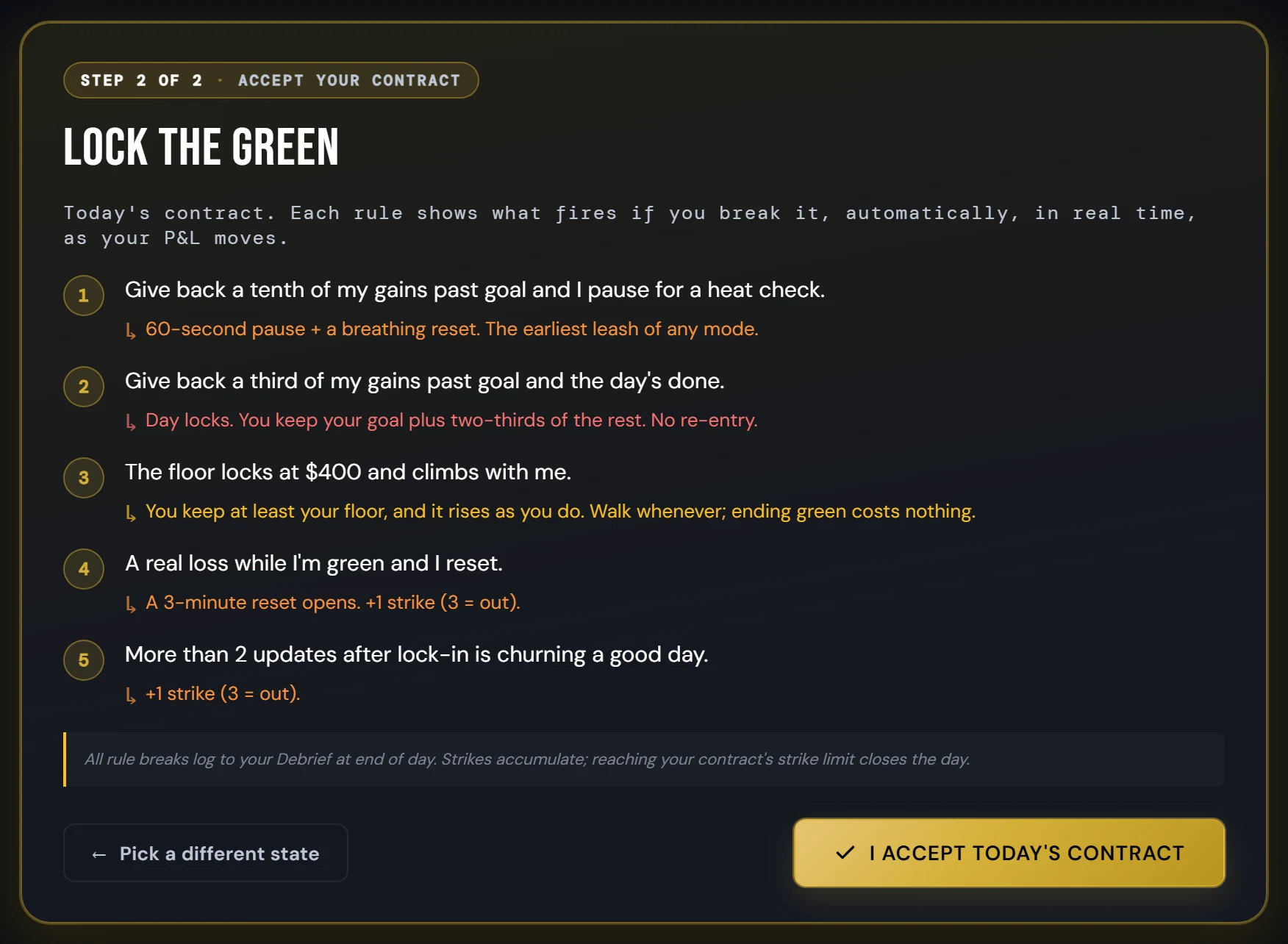
That is what MAKETZO is built around: turning the rules you wrote into behavior you can see, review and be held to. The commitment comes first, with the Morning Lock-In, before the first trade and while you are calm. During the session the Strike System and COACH SAYS catch you the moment you drift from the rules you set, in a direct voice with no excuses in it, and the Focus Room is where you reset in place of taking the next trade.
After the close, the journal does the grading. If you have In-Trade Rules, you answer each one Followed, Broke or N/A, which is the yes or no from your close with a place to go. Your Picard Score then grades how you followed your plan from 1 to 10, and it never reads your P&L. The biggest part of it is whether you followed your rules and your contract, so a green day full of broken rules reads as a warning and not a trophy.
Then comes the part a record alone never does. You write a Focus for Tomorrow, and the next morning the journal shows it back to you and asks whether you honored it. A log remembers what you did. That question remembers what you said you would do.
MAKETZO imports from DAS Trader only, and a reconciled day carries the DAS Verified badge. A net P&L typed in by hand is enough for the behavior side. Keep your reports wherever they serve you. If you are weighing Tradervue against a system built around the rule itself, that comparison says plainly where each one is the better choice. Every plan starts with a 7-day free trial, and MAKETZO will never hand you a stock pick or financial advice.
You Have Enough Data
You have had enough data for months.
The mistake keeps coming back because your journal was never in the room when you made it. It showed up afterward, took notes and let you feel better.
You do not need a better record of what you did. You need one morning when you do not do it.
Tonight, open your log, find the tag you use the most and rewrite it as one if-then sentence. Read that sentence before your first trade tomorrow, and at the close, answer one question about it: did I follow it?
Close the report. Write the rule.
Sources
[1] Kluger and DeNisi, The Effects of Feedback Interventions on Performance: A Historical Review, a Meta-Analysis, and a Preliminary Feedback Intervention Theory, Psychological Bulletin 119, no. 2 (1996): 254-284.
[2] Sheeran, Listrom and Gollwitzer, The When and How of Planning: Meta-Analysis of the Scope and Components of Implementation Intentions in 642 Tests, European Review of Social Psychology 36, no. 1 (2025): 162-194.
Photo by Maksym Kaharlytskyi on Unsplash