What Do You Mean by Scalping in Trading?
A scalper is paid in cents per share, so the only question that matters is how many cents are left when the trade is over.
Scalping means taking small gains out of short bursts of buying or selling. You are in for seconds or a few minutes, you are flat long before the close, and you may do it dozens of times in a morning. It is a form of day trading on a shorter clock. A day trader may hold for an hour to ride the morning's trend, and a swing trader holds for days. A scalper is there for one burst and leaves when the burst ends.
The word covers two different jobs. In a deep large cap with a penny spread, a scalper can work the bid and the offer for pennies. On a small cap with a 4-cent spread, that plan gets run over the first time the stock breaks out of its range, so small cap scalpers trade the burst itself: a level every trader on the stock can see, or a run that news has started. The chart tells you where to look. The tape tells you whether to act, because the job is reading how fast the prints are coming and whether offers vanish as buyers lift them. Before any scalp, name the burst you are there for and what would end it. If you cannot name both, there is no trade.
The appeal is real. You are out before a reversal can hurt you, nothing is held overnight, and a bad idea costs little if you leave when it is wrong. One number makes scalping look easier than it is: scalpers often win far more trades than they lose, and they are proud of it.
They should be suspicious of it. A high win rate is the most dangerous number in scalping, because the habits that raise it are the habits that drain the account. Follow one morning and you will see how. The morning is invented. The habit is not. Every number in it is cents per share, after the spread and fees.
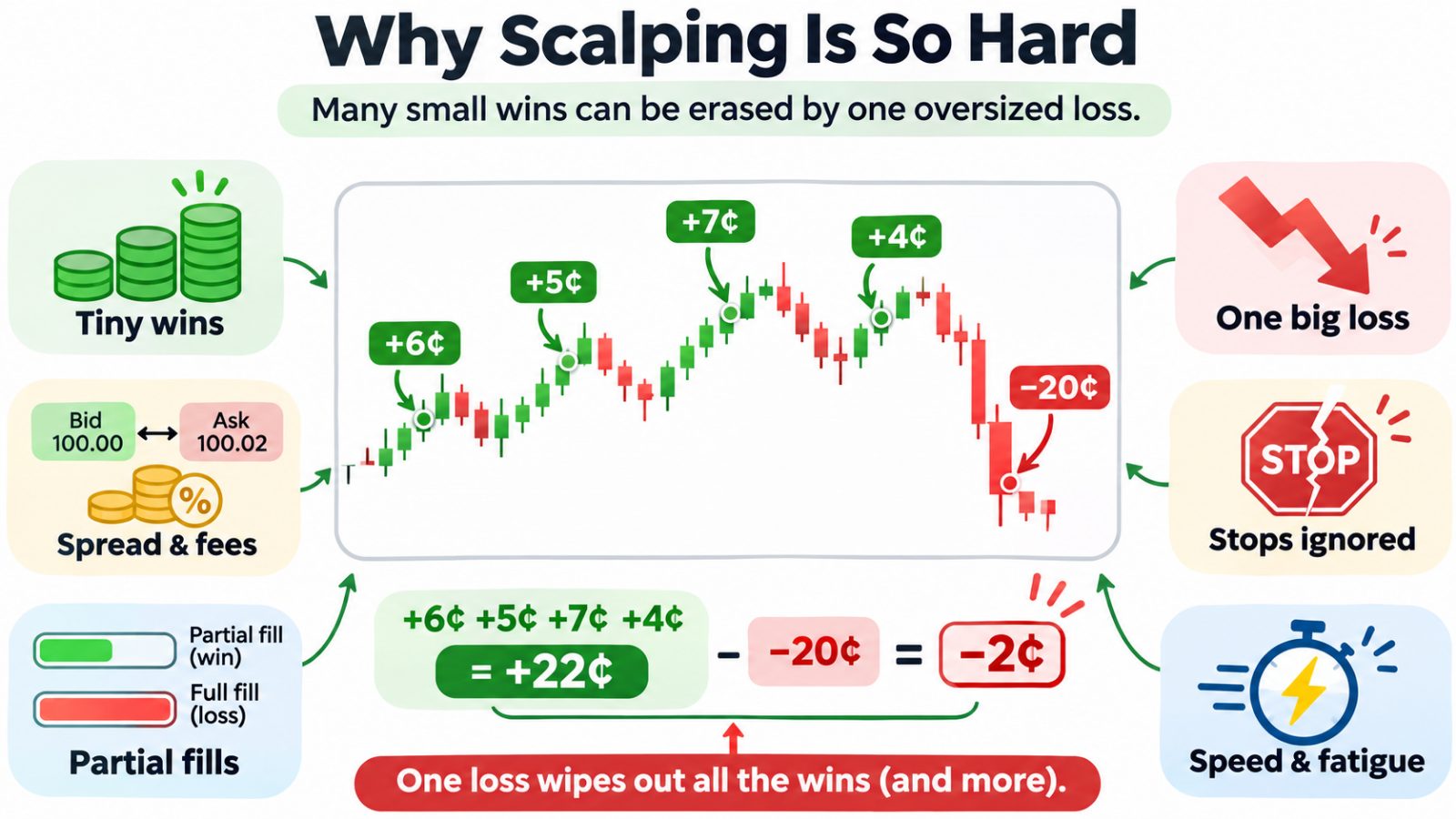
9:31 AM - Why Scalping Is So Hard
You buy the first pullback off the open. The prints speed up, you are a dime ahead before you finish exhaling, and you sell. Six cents net and the small, clean hit of being right. The stock runs another 30 cents without you.
You do that six times this morning, and all six go in the win column. Nobody ever felt bad about selling a winner, which is why nothing warns you that you just set your average win for the day at 6 cents. That is the first reason scalping is so hard. You are selling the feeling of being right, at the first price that lets you have it.
Exit on the tape instead. While offers keep vanishing and the prints stay fast, the trade is still doing what you bought it to do. Sell when the prints slow or buyers quit lifting the offer. Write your target before the order goes in, so the only thing that can talk you out of it is the tape.
The second reason is cost, which comes off the top of every trade. Take a stock quoted $5.00 bid and $5.03 offer. Buy the offer and sell the bid, and 3 cents are gone before commissions, routing and fees. A trader holding for a dollar barely notices. On a 10-cent target that is almost a third of the gain, paid again on every trade, including the ones you should have skipped. Divide the spread by your target before you trade. Write your own ceiling for that number, and pass on anything over it.
At 9:52 the third reason arrives. Your plan says you are wrong at 10 cents. You are down 10 and you do not sell, because they usually come back. Down 14. Down 19. At 9:58 it turns, and at 10:04 you get out a penny ahead.
That is the most expensive win you will have all month. It goes in the column as a win, your rate rises, and you just got paid to ignore your own stop. It happens three times this morning, and each time it makes the next one easier. Most work pays you for doing it right. A scalp can pay you for doing it wrong, and the payment teaches you to do it again.
The instinct is ordinary. In a study of about 10,000 brokerage accounts, Terrance Odean found that investors sold their winners more readily than their losers. A scalper runs that same instinct dozens of times a morning, with no time to catch it.
So keep honest books. Any trade that went past your stop and came back is a loss in your own records, however it printed. Before the open, write next to every name the price that proves you wrong.
At 10:14 the fourth reason shows up in your fills. The stock you bid takes off, and you get a third of your order. Twenty minutes later another one rolls over, and your whole order fills in an instant.
Neither one is bad luck. In a thin stock, the order that fills completely and instantly is usually the one somebody was happy to hand you, and the stock that runs gives you a piece on its way out. So your smallest fills land on your winners and your biggest land on your losers. Your win rate counts trades. Your account counts shares.
Treat an instant full fill in a thin stock as information. Read the tape the moment you are in. If heavy selling is hitting the bid and price is giving way, you are the liquidity, so take your exit at your price and not at the next one. An add on a loser gets you the full fill you wanted, on the trade you should already be out of.
The fifth reason is speed. You will make more decisions before 10:00 AM than a swing trader makes in a month, each one in seconds with money moving, and the fortieth is made by a more tired trader than the first. Some of the other side is software that reprices faster than you can see the quote change. In a small cap, some of it can be the company itself, selling new stock into the run. If you cannot watch the tape with nothing else competing for your attention, or your platform takes a beat to fill, this is the wrong style for you. A longer hold gives you time that a scalp never will.
10:40 AM - Why Most Scalpers Fail
Same setup, same plan, same reasoning as the 9:52 trade, and this time the reasoning gets to finish. Down 10, and you wait. Down 20, and you wait, because waiting has worked three times today. Down 40. There is no bid left worth the name, and when you finally sell you are down 60.
Here is your morning.
- Six quick wins at 6 cents: plus 36.
- Three comebacks at a penny: plus 3.
- One that did not come back: minus 60.
Nine wins in ten, and you finished down 21 cents a share. Your average win was a little over 4 cents and your one loss was 60, so you needed to win 93 percent of the time just to break even. You won 90 and felt good about it.
Most scalpers fail this way, and very few get past it. In a study by Chague, De-Losso and Giovannetti, 97 percent of the people who began day trading Brazilian equity futures between 2013 and 2015 and kept at it for at least 300 days lost money. In Taiwan, Barber, Lee, Liu and Odean found that less than 1 percent of day traders could predictably and reliably beat the market after fees. Neither study looked only at small cap scalpers. A scalper also pays the spread and fees far more often than a trader who takes two trades a day, so those odds are no comfort. The Brazilian study found no evidence that traders learned by day trading. Practice without honest records rehearses the habit you already have.
The failure has the same four parts almost every time.
- They score the wrong number. Win rate counts trades and says nothing about how many cents each trade kept.
- They break a stop only when it feels safe, which is how one 60-cent loss gets built out of three trades that came back.
- They keep trading after the tape slows. Every extra trade pays the spread and fees again, so the trade count climbs while cents per share falls, often on green days.
- They want it back. After the 60-cent loss, the next order is the most expensive decision of the day.
MAKETZO's Focus Room has a three-minute Loss Reset for this exact minute: a breathing ring paces you through it, a photo of what you trade for comes up, and the pause comes before the next trade.

Now run the same ten scalps with two rules: out at your stop, out at your target.
- Six winners reach a 10-cent target: plus 60.
- The three comebacks get stopped at 10 cents: minus 30.
- The 10:40 trade gets stopped at 10: minus 10.
Six wins in ten, and plus 20 cents a share. You gave up 30 points of win rate and kept 41 cents more. Real fills are messier, because some targets get missed and some stops fill worse. The shape stays the same, and it is worth getting used to: the cure looks like more red trades on your screen and more cents kept.
Nine wins lost 21 cents. Six wins made 20. That is why scalping is so hard and why most scalpers fail: the habit that wins the most trades is the habit that loses the money.
The Keys to Scalping: Win Less and Keep More
The fastest way to make more is to win less. The full method for scalping small caps, from picking the name to reading the tape, starts with that arithmetic, and seven habits keep it working when your pulse is up.
- Score cents per share, not win rate. Cents per share is net profit divided by shares traded, and it tells you whether the style is paying. Work out the win rate your averages require before you feel good about the one you have.
- Write both exits before the entry. Your stop and your target go in writing before the order goes in. A stop you decide after you are in is a negotiation.
- Pick the name you can get out of. If you cannot leave in one or two prints, it is not a scalp, whatever you call it. Check the spread, the shares at the inside and how busy the prints are before you study the chart. When a group is running, the strongest name making new highs is usually the cleaner trade, and a weak name running in sympathy fades first.
- Believe what traded over what is showing. A wall of bids can vanish the moment price gets close, so it is a clue and never a floor. Fast prints on real share counts through a level are what a move with buyers behind it looks like. When heavy selling hits a bid and price refuses to drop, someone large is buying what is offered.
- Know what your stop promises. Market and stop-market orders guarantee the fill, never the price. Limit and stop-limit orders guarantee the price, never the fill. On a low float stock that can flush, a stop-limit can leave you holding the trade it was meant to end, so decide which guarantee you need and put that order on a hotkey before the open.
- Trade the clock. The open has the heaviest volume and the most noise. By midday volume thins and price chops, and the urge to trade stays the same. The last hour picks back up as the day's trades get closed out. When the prints slow, you slow.
- Decide what ends your morning. A number of trades, a number of broken rules, a time on the clock. Write it before the open, because the trader who reaches it at 10:40 will not want to be the one choosing.
How to Use MAKETZO to Improve Your Odds
A rule is easier to sign before the open than to follow at 9:52. MAKETZO is a trading discipline system for small cap day traders, and that gap is the whole job: set your rules while you are calm, and get held to them when you are not. It teaches and it holds you accountable. It gives no stock picks and no financial advice, and it cannot make a bad setup good. What it can do is raise the odds that you do what you already decided to do, at each stage of a scalping day.
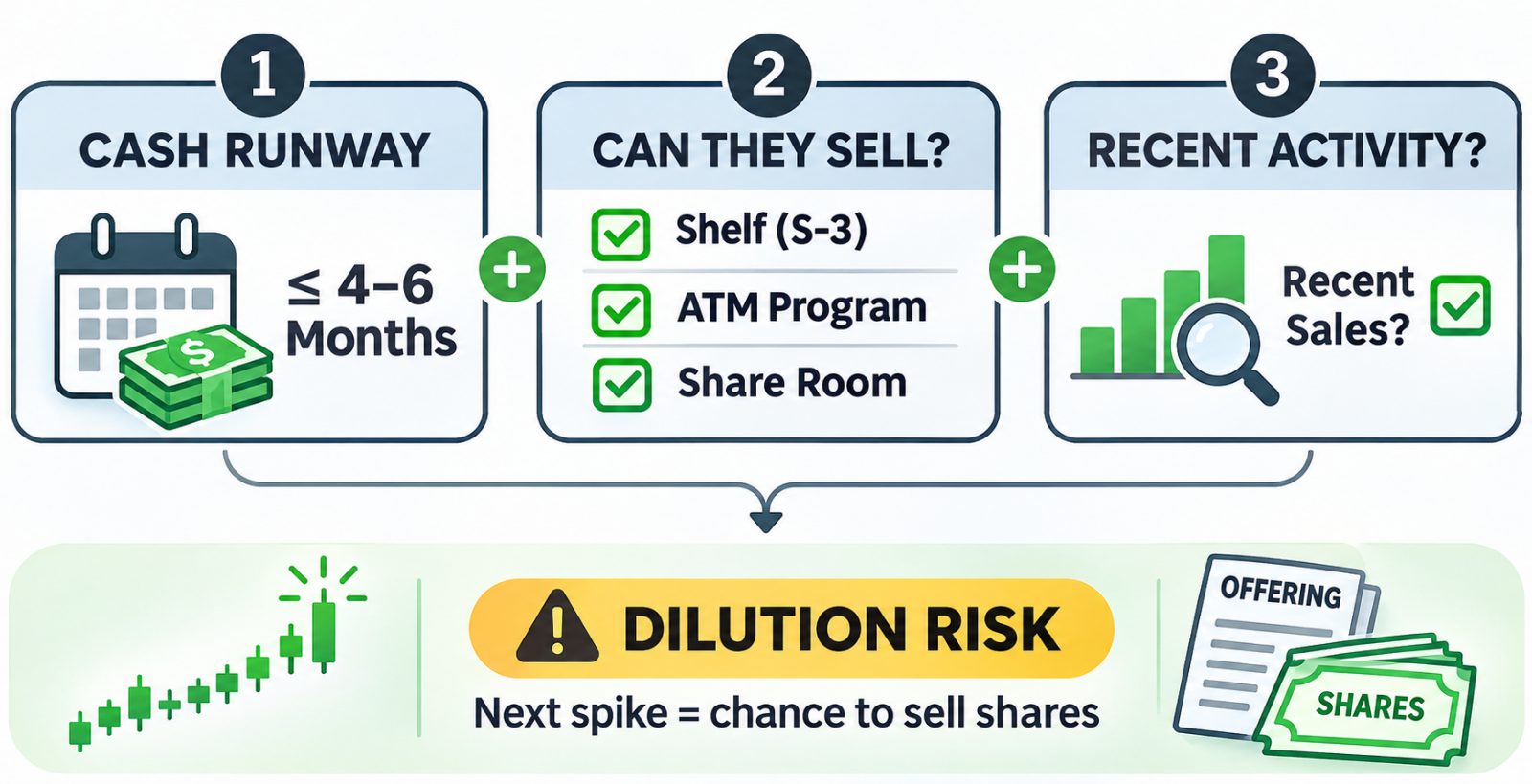
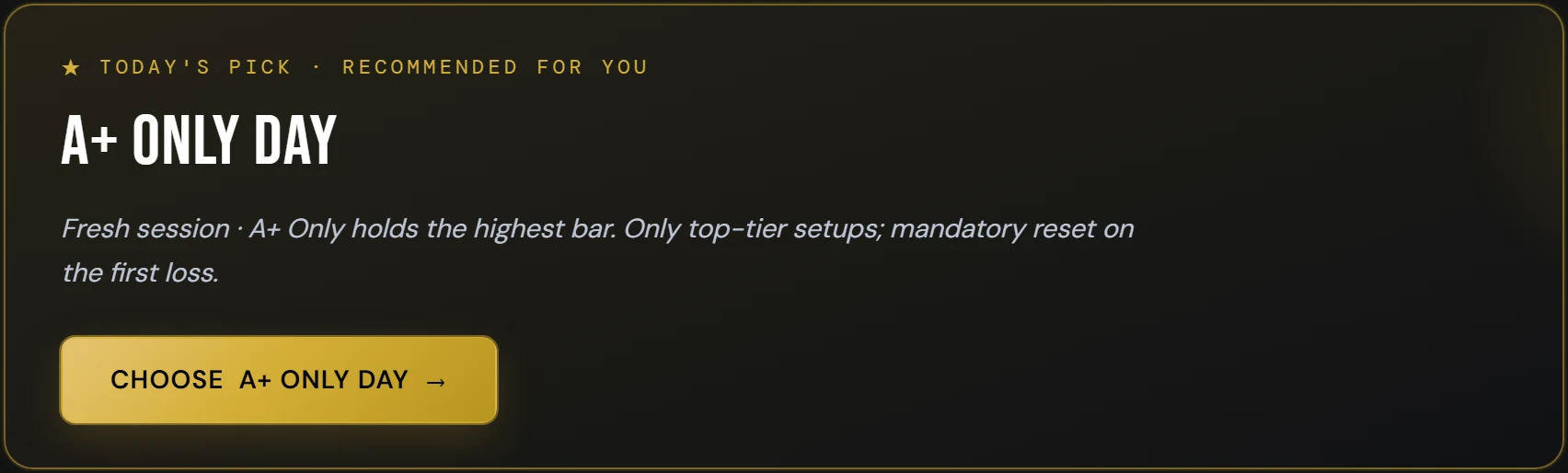
Before the open, the Morning Lock-In is where you sign your rules for the day. A contract such as A+ Only Day turns "no setup, no trade" into a rule that costs you something to break. For any small cap on your list, Dilution Check reads the company's SEC filings for dilution risk and tells you whether a selling channel is open and when it was last used. With that channel open, the company can be one of the sellers on the offer your scalp is trying to get through.
During the session, the Strike System and COACH SAYS call out the drift from those rules in direct language while it is happening, at the moment you want to re-enter after a loss or move a stop just this once. When you break a rule you set for the day, the matching reset in the Focus Room opens on its own. There is a one-minute Stop Negotiation for the trader bargaining with a stop, and a Waiting Room for the stretch when nothing is there, so a quiet tape does not turn into a bored click.
After the close, MAKETZO imports your fills from DAS Trader, the only platform it imports from. Its journal grades discipline on every trade, so a comeback that broke your rules gets marked down even when it shows green. That is the honest record a win rate will never give you. Your Picard Score grades how well you ran your process, separate from what you made. The reports chart your average hold on winners against losers and show cents per share, which is where the 9:52 habit shows up first.
Every plan starts with a 7-day free trial, so you can put a week of real scalps through it and read your own numbers.
How Much Money Does a Scalper Make? Three Things to Do Today
Only your own trades can answer that. What a scalper makes is net cents per share multiplied by the shares traded, so the figure changes with every trader and every month, and there is no honest average to quote. In the Brazilian futures study, only 0.4 percent of those who stayed at least 300 days earned more than a bank teller's US$54 a day. You can have your own number before tomorrow's open.
First, score your last 50 scalps. Count every trade that went past your stop and came back as a loss, then run four tests.
- Average win against average loss. Divide your average loss by your average win plus your average loss. That is the win rate you need, and it is often higher than the one you have.
- Time in winners against time in losers. If you stay longer in your losers, you have the 9:52 habit, whatever your win rate says.
- Shares on winners against shares on losers. If your losers carry more shares, the 10:14 fill is costing you more than your entries are.
- Your three worst trades. Take them out of the month. If the month turns green, your entries are fine and your job is to never take those three again.
If your fills come from DAS Trader, MAKETZO's reports give you the first two tests in minutes.
Second, replay your three worst trades with two rules. Pull up each chart in MAKETZO's free replay tool, which needs no account and gives you 10 replays. Enter the fills you would have made with your stop and your target held exactly, then compare the result with what you took. The gap between those two numbers is what your exits cost you.
Third, write tomorrow's card tonight. For every name on your list, write the price that proves you wrong, your target and the order you will exit with. Then write what ends your morning, and sign it. Tomorrow, count any trade that goes past that first price as a loss, however it prints. A scalper is paid in cents kept, never in trades won.